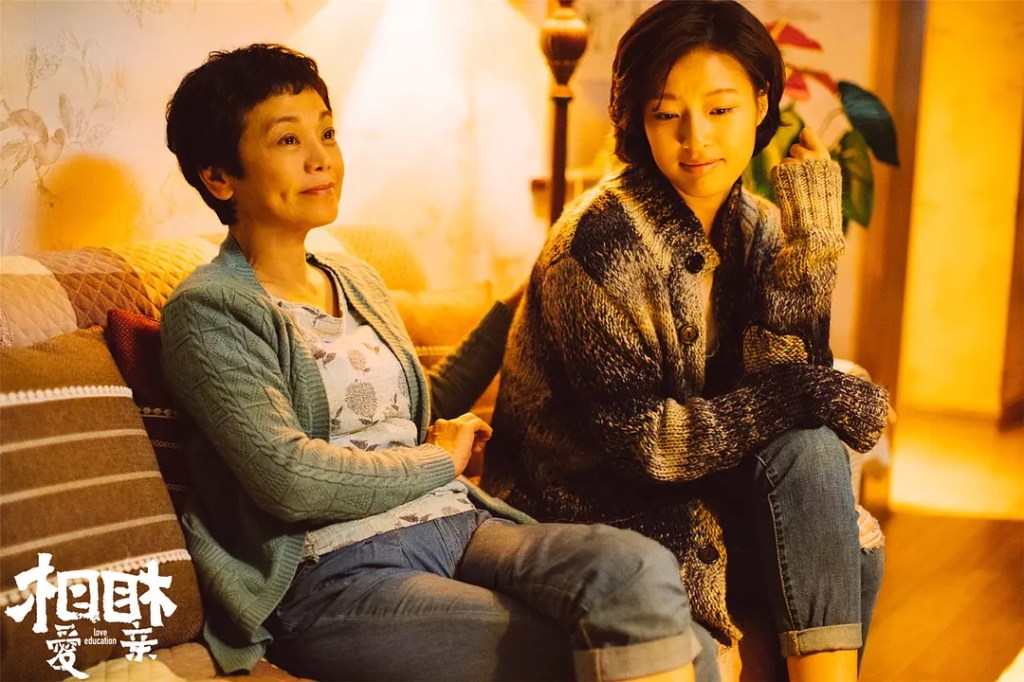
Today I watched Love Education (2017), Sylvia Chang’s deeply felt work of conscience. I remember first seeing her posts about the film on Weibo years ago — updates from the set in Henan, photos of the crew popping champagne at wrap. Even then, what struck me was not hype but sincerity: a sense of people working with quiet dedication. By now, Chang has reached the stage of her career where she no longer needs to chase attention; she films what she truly wants to film.
The film is memorable not only for its topical elements — relocating ancestral graves, the Kafkaesque bureaucracy of paperwork, the absurdities of television crews — but for how carefully it resists cheap sentiment. Chang is too astute to fall into the familiar traps of Chinese melodrama: the grandmother’s unwavering fidelity to a vanished husband, or Huiying’s rigid insistence on filial duty, could so easily have been played for saccharine tears. Instead, the film’s emotional charge lies in its restraint, in the way it renders women’s thoughts and contradictions with a tenderness that feels both raw and true.
Chang is not the kind of director who observes at arm’s length, nor one of the coolly detached chroniclers of reality so fashionable in contemporary Chinese cinema. She brings warmth, humor, and a generous empathy, yet her sentiment is never contrived. The intimacy she creates is so unforced that it disarms the viewer, making one feel less like a spectator and more like a confidant.
My own acquaintance with Chang as an actress goes back to Ang Lee’s Eat Drink Man Woman, where she played the eccentric woman who eventually marries the patriarch. Later I saw her in Stanley Kwan’s Full Moon in New York, as a rebellious daughter of a Kuomintang general chasing her stage dreams. More recently, she appeared in Jia Zhangke’s Mountains May Depart, as a Chinese teacher in Australia caught in a bizarre May–December romance — perhaps the film’s weakest link. That role seemed almost a provocation, as though Chang were deliberately seeking out unusual challenges, unwilling to be confined to conventional middle-aged female parts.
But as a director, Chang has always been most compelling when she turns her gaze toward women. Love Education is no exception: its three female protagonists — grandmother, mother, and daughter — embody not only generational differences but also three facets of womanhood, refracted through time. The grandmother represents tradition and obstinacy; Weiwei, the granddaughter, youthful candor and impulsive love; Huiying, the mother (played by Chang herself), a portrait of middle-aged contradictions — anxious, irritable, yet deeply vulnerable. Each is bound by her own inner obsession, her own “little thought,” as the Chinese phrase goes.
It is through their attitudes to love that these women come most vividly alive. For the grandmother, love is waiting — decades of fidelity to a man who abandoned her within a year of marriage, leaving only remittances and letters. For Huiying, love emerges in quarrels, sarcasm, the endless friction of daily life with a husband she nonetheless cannot do without — expressed movingly in a car scene where all her barbs dissolve into a simple dream confession. For Weiwei, love is immediate, impulsive, embodied in her pursuit of a band singer: she sneaks into bars to hear him sing, brandishes her household registration booklet to marry him on a whim, and stubbornly declares she will wait for him even as he departs to chase uncertain dreams in Beijing.
What Chang captures so deftly is the complexity of these hearts: their stubbornness, their tenderness, their contradictions. We sympathize with the grandmother’s lifelong devotion even as we are unsettled by its futility; we admire Huiying’s competence while bristling at her volatility; we delight in Weiwei’s boldness while cringing at her immaturity. Yet it is precisely this insistence — this refusal to let go of what matters most in their hearts — that gives them resilience. Chang suggests that it is women’s tenacity, their capacity to cling to love in its many guises, that sustains them through life’s harshest passages.
Unlike the overt polemics of feminist cinema, Love Education grounds itself in the quotidian. It does not sermonise. Instead, it makes visible the kind of women we recognise around us — even, perhaps, within ourselves. In this lies its quiet radicalism. Western films like Nymphomaniac may seek to shock by grafting masculine behaviours onto female bodies, but Chang locates power elsewhere: in patience, in tenderness, in the stubborn dignity of women who endure.
What moved me most was how unabashedly she reveals women’s inner landscapes. The grandmother clings to a marriage that barely existed, turning memory into a fortress; Huiying hides her devotion behind quarrels, yet dreams of her husband’s young face with the innocence of a girl; Weiwei brandishes her love with reckless pride, telling her grandmother, “This is my boyfriend — handsome, isn’t he? Even my mom hasn’t seen him yet.” These gestures, tender and foolish and brave, cut across generations.
Perhaps that is Chang’s achievement: to show us that in the end, women are bound not by ideology but by their capacity to love and to wait, to err and to endure. Love Education is a rare film that makes you leave the cinema not heavy-hearted but warmed — a reminder that within each of us lies that unyielding thread of devotion, and in dreams, we still glimpse the beloved at their most radiant.
 Tu Yao 涂遥
Leave a comment